Behind every well-built handbag or every wallet that ages without losing its shape, there is a leather goods maker. This is the craftsperson, not always visible to the public, who cuts the hide, assembles it and adds the final touches. Here, in our Couture section, is what this craft really involves, the techniques it demands, the diplomas that lead to it, and the houses that keep it alive.
The diplomas that lead to the leather goods trade
| Diploma | Duration | Entry | What it trains |
|---|---|---|---|
| CAP maroquinerie | 2 years | After lower secondary school | Cutting, assembly, stitching and finishing of leather items |
| Vocational bac in leather trades (leather goods or saddlery options) | 3 years | After lower secondary school or after a CAP | Prototyping, assembly and running a fuller production |
| BTS in fashion, footwear and leather goods | 2 years | After the bac | Design work, workshop supervision, industrialisation |
Leather goods maker: definition and materials
A leather goods maker produces accessories in leather: handbags, belts, wallets, watch straps, gloves or luggage. Leather and hides remain the craft’s main materials, but it also works fabric, synthetic materials, recycled materials and so-called “vegan” leather, which comes from no animal. The most common hides stay cowhide, calfskin and goatskin, sturdy and easy to work with day to day; some houses also use rarer leathers, from suede to shagreen, each with its own cutting and finishing rules.
A closely related craft is defined by its object rather than its gestures: the saddler, who specialises in making saddles and in trimming interiors or objects, notably for cars and boats, while the leather goods maker stays focused on bags, wallets, belts and small leather goods.
The craft is practised in two quite distinct settings. In an independent workshop, a leather goods maker controls the whole process, from choosing the material through to the finishing touches, and can design their own pieces or work to made-to-order commissions, much like the workshops that carry the work of haute couture over into leather. In industry, driven by luxury houses that recruit and subcontract, tasks split further into specialties: pattern maker, cutter, stitcher or assembler work in small teams, and an experienced leather goods maker can go on to run a workshop.
The craft’s gestures, from cutting to finishing
The work always follows the same sequence, whatever the object being made.
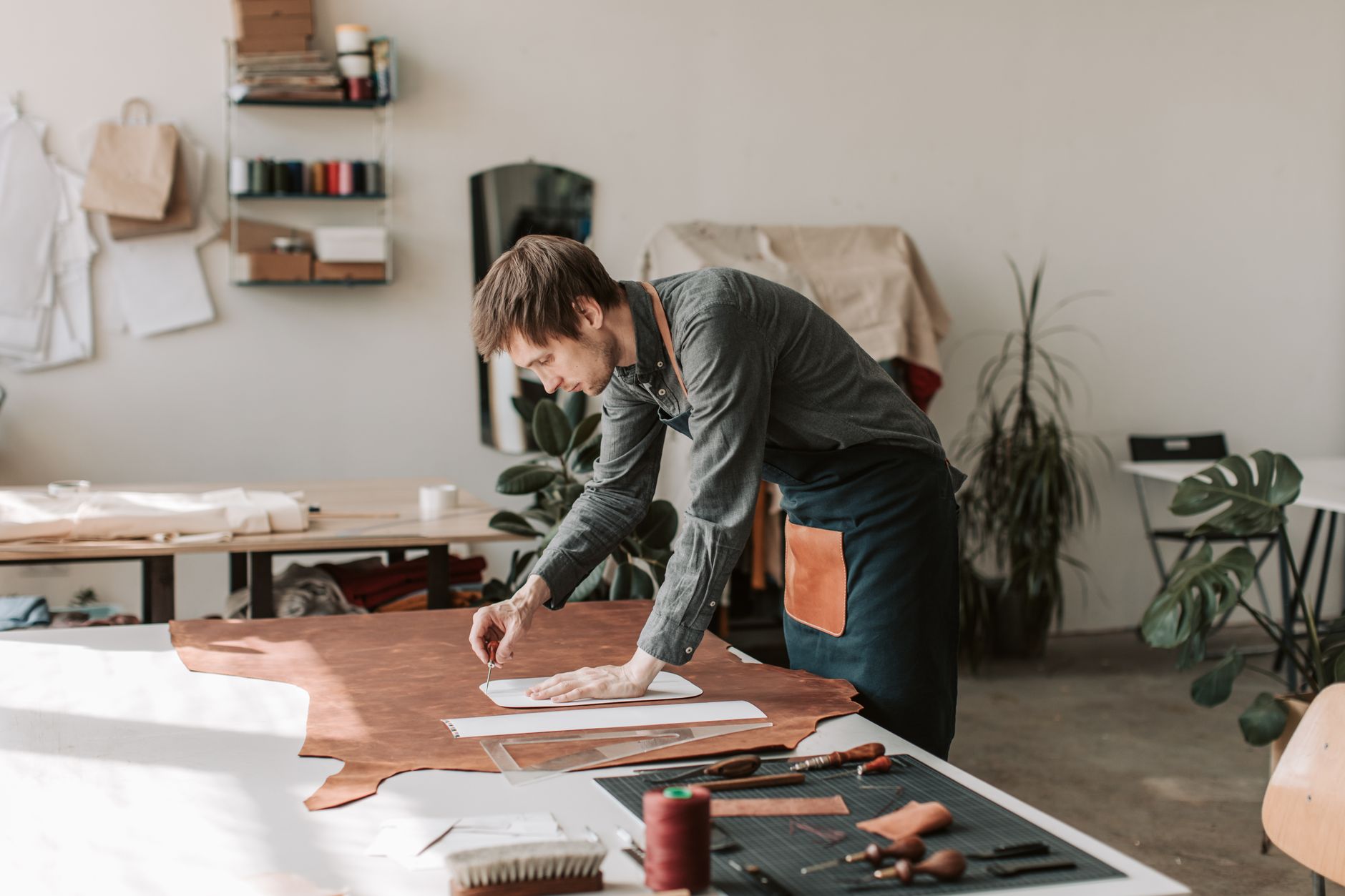
Cutting comes first: starting from a pattern or a drawn prototype, the leather goods maker chooses the hide, reads its shading and flaws, then positions the pieces along the grain to limit waste, since leather remains a costly material. Which part of the hide goes where matters too: the most even section is kept for the outside of the piece, while a section with small flaws is kept for the lining, invisible once the object is assembled. Cutting is done by hand, with a die-press, or increasingly with a laser.
Next come the treatments applied to the hide: splitting to adjust its thickness, skiving the edges to reduce bulk at the seams, then burnishing and glazing under a hot press to give the leather its shine.
Assembly brings the pieces together by hand or machine stitching, riveting, welding or sewing, before fitting zips, linings and straps. Finishing adds the last pieces of hardware, buckles, snaps or clasps, and a quality check runs through every step, from the first cut to the finished object.
The craft’s tools have changed little in principle: the awl remains the tool for saddle-stitched handwork, now joined by sewing machines, hydraulic presses, die-presses and splitting or skiving machines. Laser cutting simplifies some steps without replacing the eye of the practitioner, who remains the sole judge of a hide’s quality.
Training, from CAP to BTS
The entry level for the craft remains the CAP or an equivalent diploma. The most direct route, the CAP maroquinerie, is taken over two years after lower secondary school and trains in cutting, assembly, stitching and finishing leather items; related CAPs in shoemaking, general saddlery or harness saddlery open onto nearby specialties.
The vocational bac in leather trades, over three years, is taken after lower secondary school or after a CAP, with a leather goods option or a saddlery option, and goes deeper into prototyping and running a fuller production. To aim at design work or workshop supervision, a BTS in fashion, footwear and leather goods, taken after the bac, rounds off the training over two years. These paths run through vocational schools or apprenticeship centres, and above all call for a sharp sense of touch and manual dexterity, since the quality of a hide can only be judged by hand.
The CAP maroquinerie and the vocational bac in leather trades (leather goods option) are also taught as apprenticeships inside the Compagnons du Devoir et du Tour de France network, which runs several training centres dedicated to leather, in Pantin and in Cholet. The LVMH group draws on this same network for part of its Institut des Métiers d’Excellence.
The houses that train and employ leather goods makers
The luxury industry, a major user of this craft, sometimes struggles to recruit through the ordinary job market: several houses have therefore built their own training routes. In 2014, the LVMH group announced the creation of the Institut des Métiers d’Excellence, a programme that prepares recognised diplomas through paid apprenticeship contracts, run directly inside the group’s houses, to pass leather goods making and other craft trades on to younger generations.
Other luxury houses have followed a similar path with their own in-house schools, alongside the public CAP and vocational bac routes. This choice says something about the craft: mastering a hide, its shading and its tolerances, is not something taught from a book alone, it is passed on above all through contact with a workshop.
How much a leather goods maker earns
According to Onisep, a leather goods maker’s starting salary sits around 1,867 euros gross per month in France. In industry, a leather goods worker most often starts at the minimum wage, a level that then rises with experience, the skill acquired and the responsibilities taken on in the workshop, up to running a small team for the most seasoned profiles.
Pay also depends on the setting: an independent craftsperson selling their own pieces, sometimes in made-to-measure stretch leather, does not sit on the same pay scale as an employee in an industrial workshop, where splitting tasks between cutting, stitching and assembly is the norm.
What to remember
- A leather goods maker produces leather accessories, from cutting the hide through to finishing, in an independent workshop or an industrial one.
- The CAP maroquinerie (2 years) remains the most direct entry route, extended by a vocational bac in leather trades (3 years) and then a BTS in fashion, footwear and leather goods (2 years).
- The craft’s gestures, cutting, skiving, assembly and finishing, apply just as much to an everyday bag as to a piece in an exotic or rarer leather such as suede.
- The starting salary sits around 1,867 euros gross per month, and several luxury houses now train their own future leather goods makers through apprenticeship.