A former psychomotor therapist turned designer, a Nice boutique opened in 1976, a Paris house founded in 1983: Jean-Claude Jitrois moved from psychomotor therapy to fashion design. That detour explains how he works leather, treated as a second skin rather than a rigid material. Here is his work and his house, from the boutiques of the French Riviera to stretch leather.
From the French Riviera boutiques to the founding of the house (1944-1983)
Jean-Claude Jitrois was born on 10 January 1944 in Narbonne as Jean-Claude Coste. His initial training had nothing to do with fashion: he studied psychomotor therapy at the Salpêtrière hospital in Paris, then ran the Institut Supérieur de Rééducation Psychomotrice in Nice until 1976, where he also published several books on the discipline.
In 1976, he opened his first boutique in Nice, then expanded into Juan-les-Pins and Antibes. In 1979, a new address opened in Saint-Tropez, first near the port then on rue de la Ponche. This Riviera period already shaped the aesthetic that would become his signature, a visceral relationship to clothing, built from the body and its movement rather than from the drawing of the garment alone, a direct legacy of his training as a psychomotor therapist.
A clientele of artists, from Nice to Saint-Tropez
From the opening of the Nice boutique, Jean-Claude Jitrois attracted a clientele of artists and public figures, including the artist Niki de Saint Phalle, the sculptor Ben and Princess Stéphanie of Monaco. The Saint-Tropez address confirmed this international audience, frequented notably by Caroline of Monaco, Cher, Joan Collins, Elton John and Brigitte Bardot.
This closeness to the world of entertainment continued after the move to Paris. In the 1980s and 1990s, artists such as Johnny Hallyday, Brigitte Nielsen or Céline Dion appeared in Jitrois creations. From the 2000s onward, international performers such as Lady Gaga, Beyoncé, Mary J. Blige or FKA twigs wore the house in turn, which has more recently been associated with outfits worn by Brigitte Macron. These public appearances document the house’s public visibility, separate from its founder’s private life.
1983: the Jitrois house settles in Paris
In 1983, the Jitrois house was officially founded with the opening of its own first boutique at 38 rue du Faubourg-Saint-Honoré in Paris. There, the designer built a wardrobe entirely constructed around leather, treated not as a secondary material reserved for jackets and coats, but as a creative textile in its own right.
In 1988, he launched an eponymous perfume, created by the perfumer Jean-Claude Ellena. The following decade confirmed the house’s Paris roots, as it regularly worked with recognised fashion photographers to document its collections.
Leather couture, a material worked like haute couture
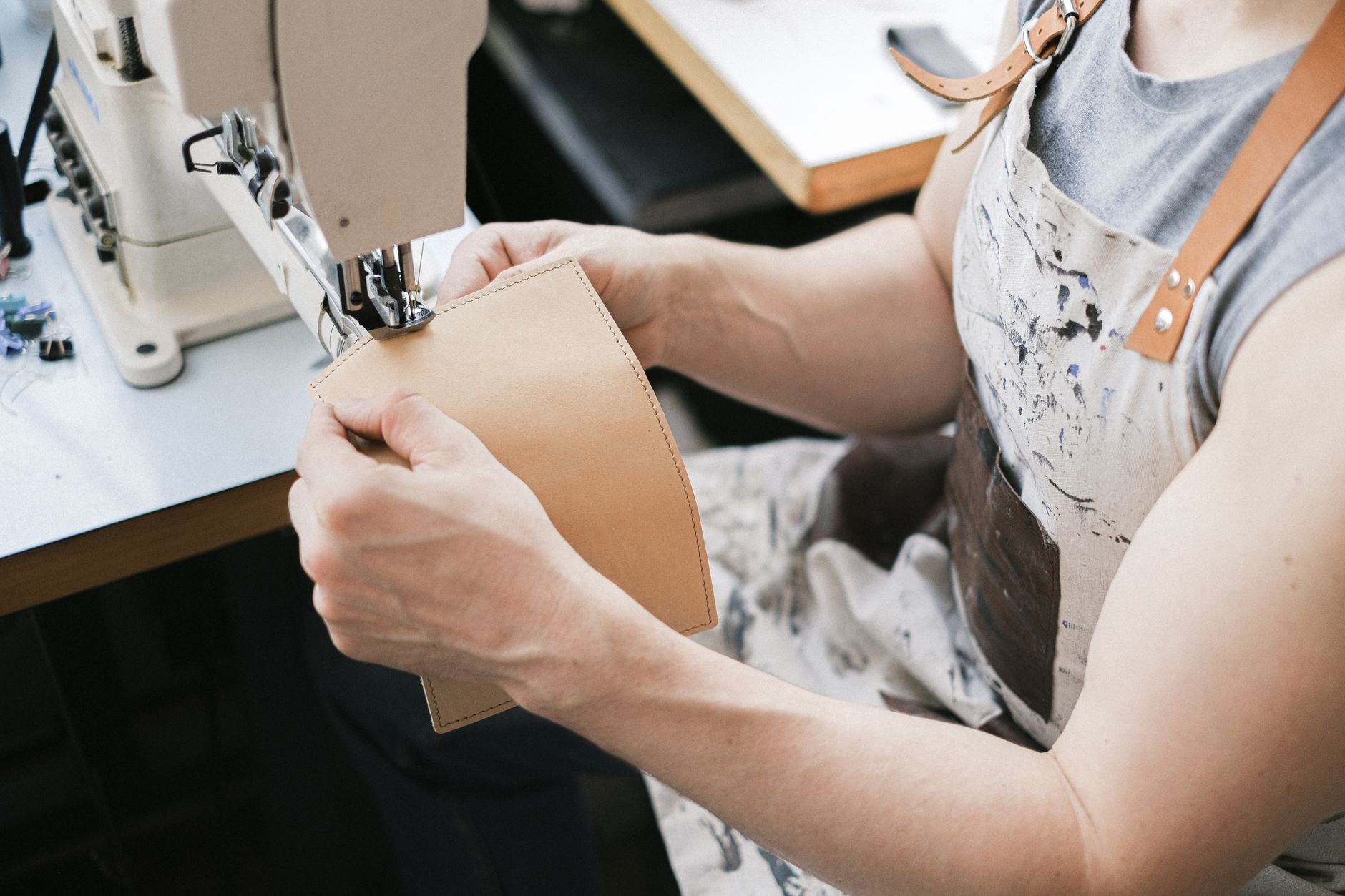
In the 1980s, Jean-Claude Jitrois worked leather in colour and made it a couture material: sculpted dresses, marked shoulder volumes, fitted waists, embroidery. Leather stopped being confined to utilitarian garments and became a construction medium, shaped like a piece worked in an atelier.
Without claiming the haute couture label, reserved for houses accredited by the Chambre syndicale and to specific criteria (detailed here), Jitrois presents its leather work as drawing on couture-like methods: fitted cutting and piece-by-piece construction.
1995: stretch leather in the Jitrois collection, with DuPont de Nemours
Jean-Claude Jitrois’s best-known contribution remains the introduction of stretch leather in collection, in 1995, following a collaboration with the American chemical company DuPont de Nemours, which developed in the early 1990s an elastic fibre adapted to a new use: serving as a backing for a hide rather than for a conventional textile.
The technical principle comes down to one step: a finely split lamb nappa top grain is laminated onto a cotton base loaded with elastane. The result is no longer a hide alone but a composite, which keeps the look and feel of leather while gaining an elastic stretch. Until then, leather imposed garments designed with volume. Stretch allows fitted pieces worn close to the body: a dress, trousers or a jumpsuit. The full history of stretch leather, its three contributors and the dates of each step, can be found in our article on who invented stretch leather, and the exact composition of the material in our stretch leather definition.
In 2009, the house extended this logic with a machine-washable leather jean, another first claimed by Jitrois in the field of leather.
Collections shot by Lagerfeld, Newton, Mondino and Rankin
Over the decades, Jean-Claude Jitrois built the image of his collections with some of the most recognised names in fashion photography. In 1997, the “Venitien” collection was photographed by Karl Lagerfeld. The following year, the Minoray collection and the Skin Jean were shot by Helmut Newton. In 2002, Jean-Baptiste Mondino took over the house’s collection imagery, then from 2010 to 2015 the British photographer Rankin took the relay.
This continuity of collaborations with major names in fashion photography helped build a recognisable visual identity, centred on the body and the material rather than on accessories or sets. To place this approach to leather within the broader history of leather garments in fashion, our Style section covers other pieces and houses that have marked this field, from the perfecto jacket to recent runways.
Recognition: the Legion of Honour, the Chambre syndicale and an autobiography
In 2012, the Jitrois house joined the Chambre syndicale du prêt-à-porter des couturiers et des créateurs de mode, which brings together French fashion houses recognised by the industry outside the narrower circle of haute couture. The same year, Jean-Claude Jitrois, already made a Knight of the Legion of Honour in 2001, was promoted to Officer.
In 2024, he published the autobiography “Ma peau se souvient”, retracing his professional path, from psychomotor therapy to founding his house and introducing stretch leather in collection. Through this book, as through his earlier works on psychomotor therapy published between 1975 and 1977, Jean-Claude Jitrois has consistently linked his work as a designer to his initial training on the body and movement.
This dual background, therapeutic then creative, is one of the keys to reading his work, as the house’s website presents it. The leather garment is never conceived there as a rigid shell, but as a support for gesture and posture, an approach that explains the house’s consistency on this ground for more than forty years, well beyond the single episode of stretch leather.
Key dates for Jean-Claude Jitrois
| Year | Milestone |
|---|---|
| 1944 | Born in Narbonne as Jean-Claude Coste |
| 1976 | End of his tenure running the Institut Supérieur de Rééducation Psychomotrice in Nice; first boutique opens in Nice |
| 1979 | A boutique opens in Saint-Tropez |
| 1983 | The Jitrois house is founded in Paris, on rue du Faubourg-Saint-Honoré |
| 1988 | Launch of the eponymous perfume, composed by Jean-Claude Ellena |
| 1995 | Stretch leather introduced in collection, with DuPont de Nemours |
| 1997-1998 | Collections photographed by Karl Lagerfeld then Helmut Newton |
| 2001 | Knight of the Legion of Honour |
| 2009 | First machine-washable leather jean |
| 2012 | Officer of the Legion of Honour; joins the Chambre syndicale du prêt-à-porter des couturiers et des créateurs de mode |
| 2024 | Publication of the autobiography “Ma peau se souvient” |